Be yourself; Everyone else is already taken.
— Oscar Wilde.
This is the first post on my new blog. I’m just getting this new blog going, so stay tuned for more. Subscribe below to get notified when I post new updates.
Be yourself; Everyone else is already taken.
— Oscar Wilde.
This is the first post on my new blog. I’m just getting this new blog going, so stay tuned for more. Subscribe below to get notified when I post new updates.
Unemployment in Least Developed Economies
The term unemployment refers to any resource or factor of production which remains unused or underutilized in the economy. Human beings are one of the major resources for production to take place in any economy, but excess of any resource in relation to its necessity is considered a wasteful resource. Such is the situation of a lot of unemployed people of today. Many studies have indicated a positive correlation between rapid population growth rate and unemployment. Population growth is increasing at a faster pace than that of job creation, the natural result is unemployment. The United Nations projects world population to reach 10 billion in the year 2056. This is a clear indicator of the extremely high rate of population growth in the past years. Although the general trend of population growth rate and fertility rates are decreasing, job creation requirements, at least in the next two decades still poses a problem, as they reflect the addition to population of the preceding two decades who will now become the current working age population. There has been a projected increase of about 21% in the working population. At this rate, the global labour markets will have to produce more than half a billion jobs more to keep up with the growing working population. The challenge of job creation in general is further worsened by various other macroeconomic factors apart from population explosion.
Population Growth
Although population growth is not the only factor for unemployment, it is one of the driving forces. The population growth from 1959 to 1999 has increased from 3 Billion to 6 Billion, as can be seen from the table below, which is a 100% increase.
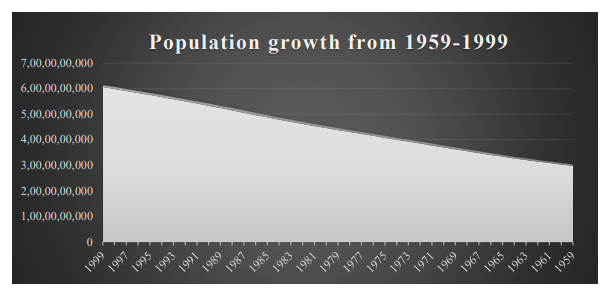
Source: United Nations, Department of Economic and Social Affairs, Population Division.
Population growth rate has taken place at an alarming rate. Population is a desirable feature only until the point where it is enough to engage its populace in meaningful productive activity. Once it exceeds such a limit, unemployment of various forms (Disguised unemployment, underemployment, seasonal unemployment) is inevitable. Much of this growth is attributed to Least Developed Countries. Population explosion as well as massive unemployment are, unfortunately, two major features of LDCs. At the moment, approximately 855 million people are residing in the LDCs. The total population of the 48 least developed countries is rising today almost twice as rapid as that of the developing world: at 2% per annum and 1.2% annually. Over the subsequent forty years the LDCs populace will rise by approximately 100%, as stated by the United Nations Conference on Trade and Development (UNCTAD) “The Least Developed Countries Report 2011”. Between 2005 and 2010, the average fertility rate of the LDCs was 4.4 (compared with 2.5 in other developing countries), and the average population growth rate was 2% (compared with 1.2 in other developing countries). Owing to high fertility, the population of the LDCs is expected to nearly double and increase to 1.67 billion between now and 2050 and this will result in a large and growing youth population. Today about 60 per cent of the population in LDCs is under the age of 25, and the number of young people in the LDCs will increase by more than 60 per cent over the next forty years.(United Nations Population Fund (UNFPA) “Population Dynamics in the LDCs: Challenges and Opportunities for Development and Poverty Reduction”.)
Impact of high growth rate of population on unemployment
Given the fact that LDCs are characterised by high growth rate of population (Nigeria growing at 54.9%, Columbia growing at 64.1%, Karachi growing at 46.1% according to Todaro MP, Smith, 2011) as well as massive unemployment, the labour market is facing a harmful phenomenon. As much as unemployment rises, the number of unemployed rises too, adding to the pool of already unemployed persons. In such a situation, even those who are employed live in fear of losing their jobs. This relationship of population growth and unemployment has also been proved in the case of the economy of Pakistan by Kalim in 2003 through a simple regression model using the data set for 13 years from 1986-1999, and a positive relationship was obtained. This is true for most of the developing economies in the world.
The given below chart represents the population growth rate between 1955 to 1990 in South Africa, a period when the percentage increase in the population was quite large.
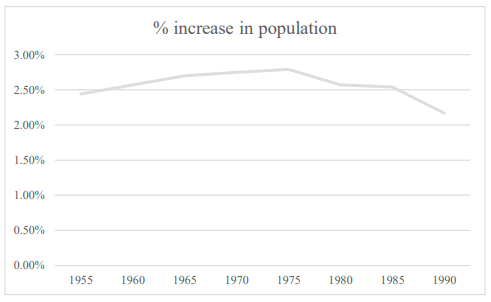
Source: Department of Economic and Social Affairs, Population Division
The given chart below represents the unemployment rate in South Africa from 1991 to 2007, which is approximately at the time when the population born in the above mentioned time period, would come of working and employable age.
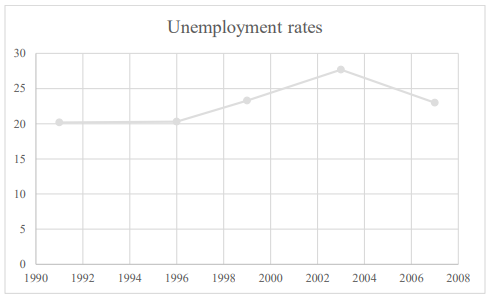
Source: CIA World Factbook
2003 was the year in which the unemployment rate was the highest, of 27.7%. There are many factors contributing to this unemployment rate, and population was one of the key factors, as can be seen from the above two graphs. Excess population growth rate in relation to job creation also results in qualified personnel getting jobs mostly in the informal sector. “In sub-Saharan Africa, poor-quality employment – rather than unemployment – remains the main labour market challenge. This problem is compounded by rapid population growth, specifically growth of the working-age population,” states the ILO’s World Employment Social Outlook 2017 report. This phenomenon of youths graduating from tertiary institutions often taking up jobs of the informal sector, jobs that require school level education, is quite common in LCDs due to lack of employment opportunities. This situation only gets worse when millions more are pumped into the labour market.
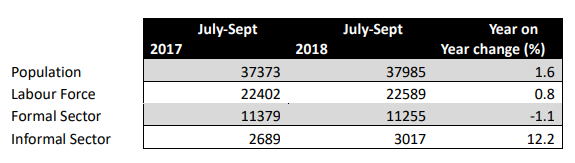
Source: Stats SA
The above table gives the data of the labour market in South Africa of 2017 (July-Sept) and 2018 (July-Sept). There has been a growth rate in labour force by 0.8%, but they have been absorbed in the informal sector in the economy and not in the formal sector. In fact, some of those who were employed in the formal sector, have either lost their jobs, or shifted to the informal sector. Policy
Suggestions and Conclusion
There are already many efforts being made in order to curb the problem of population explosion. Education and awareness coupled with knowledge of family planning is a must to the citizens of any economy undergoing a population crisis. The government in such nations need to make a conscious effort at providing the necessary kind of education. African government have now formally established “Family Planning Programmes” according to the International Planned Parenthood Federation. Emphasis should be laid on primary and secondary education, especially in the rural areas to provide a strong foundation which will go on to improve productivity of an individual, and thereby of the entire workforce. The government must focus its policies on trying to reduce fertility and birth rates. Incentives can be a good policy measure to curb this issue, such as discounted education for families with two or less children. Apart from this, policies which result in employment generation should be taken up. Agriculture is one sector which employs the most number of people and the development of this sector should get its due importance. This can be done through policy measures to upgrade technology, improving skills, raising productivity and shifting focus to commercial crops. As the Malthusian Growth Theory states that the birth rate increases in a geometric progression whereas increase in food supply happens in an arithmetic progression. This theory is applicable to an extent in the current scenario of overpopulation as well. If we don’t keep a check on population, it will outgrow the resources. In such a scenario, the nation will be left with a frustrated working age population who are unable to find employment opportunities.
References
Our urbanizing world. (2014, August). Retrieved from http://www.unpopulation.org/ The Least Developed Countries Report. (2011, November 17). Retrieved from https://unctad.org/en/pages/aldc/Least Developed Countries/The-Least-Developed-CountriesReport.aspx
Herrmann, JM, G., S, J., & D, S. (1970, January 01). Population dynamics in the least developed countries: Challenges and opportunities for development and poverty reduction. Retrieved from https://www.popline.org/node/217513
World Population Policy 2009 publication. (n.d.). Retrieved from https://www.un.org/en/development/desa/population/publications/policy/world-populationpolicies-2011.asp
South Africa Unemployment Rate [1990 – 2019] [Data & Charts]. (n.d.). Retrieved from https://www.ceicdata.com/en/indicator/south-africa/unemployment-rate
Africa, S. S. (n.d.). Youth graduate unemployment rate increases in Q1: 2019. Retrieved from http://www.statssa.gov.za/?p=12121
This is an example post, originally published as part of Blogging University. Enroll in one of our ten programs, and start your blog right.
You’re going to publish a post today. Don’t worry about how your blog looks. Don’t worry if you haven’t given it a name yet, or you’re feeling overwhelmed. Just click the “New Post” button, and tell us why you’re here.
Why do this?
The post can be short or long, a personal intro to your life or a bloggy mission statement, a manifesto for the future or a simple outline of your the types of things you hope to publish.
To help you get started, here are a few questions:
You’re not locked into any of this; one of the wonderful things about blogs is how they constantly evolve as we learn, grow, and interact with one another — but it’s good to know where and why you started, and articulating your goals may just give you a few other post ideas.
Can’t think how to get started? Just write the first thing that pops into your head. Anne Lamott, author of a book on writing we love, says that you need to give yourself permission to write a “crappy first draft”. Anne makes a great point — just start writing, and worry about editing it later.
When you’re ready to publish, give your post three to five tags that describe your blog’s focus — writing, photography, fiction, parenting, food, cars, movies, sports, whatever. These tags will help others who care about your topics find you in the Reader. Make sure one of the tags is “zerotohero,” so other new bloggers can find you, too.

 EconBrowser